Companies House Filing Deadlines Explained: A Complete UK Business Guide
Missing a deadline at Companies House is one of the easiest mistakes a director can make, and one of the most avoidable. The result can be an automatic penalty, a poor compliance record and, in serious cases, prosecution or strike-off.
This guide explains the main dates, what happens if you miss them and how to stay organised. It reflects official GOV.UK guidance as of November 2026, so check the official pages before you file.
What Are Companies House Filing Deadlines?
Every UK limited company must keep the public register up to date. Filing deadlines are the legal dates by which it must deliver accounts, a confirmation statement and notice of changes. Directors remain responsible even when an accountant or bookkeeper does the work.
Key Companies House Filing Deadlines Every Director Should Know
- Annual accounts: within nine months of the end of the company’s financial year (private companies).
- First accounts: within 21 months of the date the company was incorporated.
- Confirmation statement: within 14 days of the end of each 12 month review period.
- Director changes: appointments and resignations must be notified within 14 days.
- Registered office and other details: update them promptly. This is good practice rather than a fixed deadline.
- Identity verification: existing directors and people with significant control must verify their identity before the next confirmation statement, and no later than 18 November 2026, when the transition period ends. An unverified director can block the filing.
Corporation Tax deadlines are set by HMRC, not Companies House, so they are tracked separately.
Annual Accounts vs Confirmation Statement
These are often confused, but they do different jobs.
| Annual accounts | Confirmation statement | |
|---|---|---|
| Purpose | Financial snapshot for the year | Confirms company details are correct |
| Frequency | Once a year | At least once every 12 months |
| Deadline | Nine months after year end | 14 days after the review period ends |
A confirmation statement covers details such as the registered office, directors and shareholders. You can file it early, which starts a new review period. Read the full confirmation statement guidance on GOV.UK.
Filing Deadlines for New Companies
A new company’s first accounts are due 21 months after incorporation, not after the first year end. After that, accounts follow the usual nine month rule.
The confirmation statement runs on its own clock. If a company is incorporated on 1 April 2026, its first review period ends on 31 March 2027, and the statement is due by 14 April 2027.
What Happens If You Miss a Filing Deadline?
Late accounts trigger an automatic penalty for private companies, with no warning:
- Up to one month late: £150
- One to three months late: £375
- Three to six months late: £750
- More than six months late: £1,500
These amounts double if accounts are late in two years in a row. Full details are in the late filing penalties guidance.
A late confirmation statement works differently. The company and its officers may be prosecuted, and the company may be struck off the register. Overdue records are also public, so banks and suppliers can see them.
How to Keep Track of Important Company Filing Dates
- Calendar reminders: set alerts at 60, 30, 14 and 7 days before each deadline.
- Compliance spreadsheet: list each company number, accounts due date, confirmation date and who is responsible.
- Digital tracking tools: useful if you manage several companies.
- Regular record checks: look at the register every few months.
Common Companies House Filing Mistakes
- Assuming your accountant has it covered without confirming.
- Mixing up HMRC and Companies House deadlines.
- Leaving filing to the last day. Late delivery still counts as late.
- Leaving identity verification until the last minute.
- Ignoring letters sent to the registered office.
How Companies on the Go Helps Business Owners Stay Organised
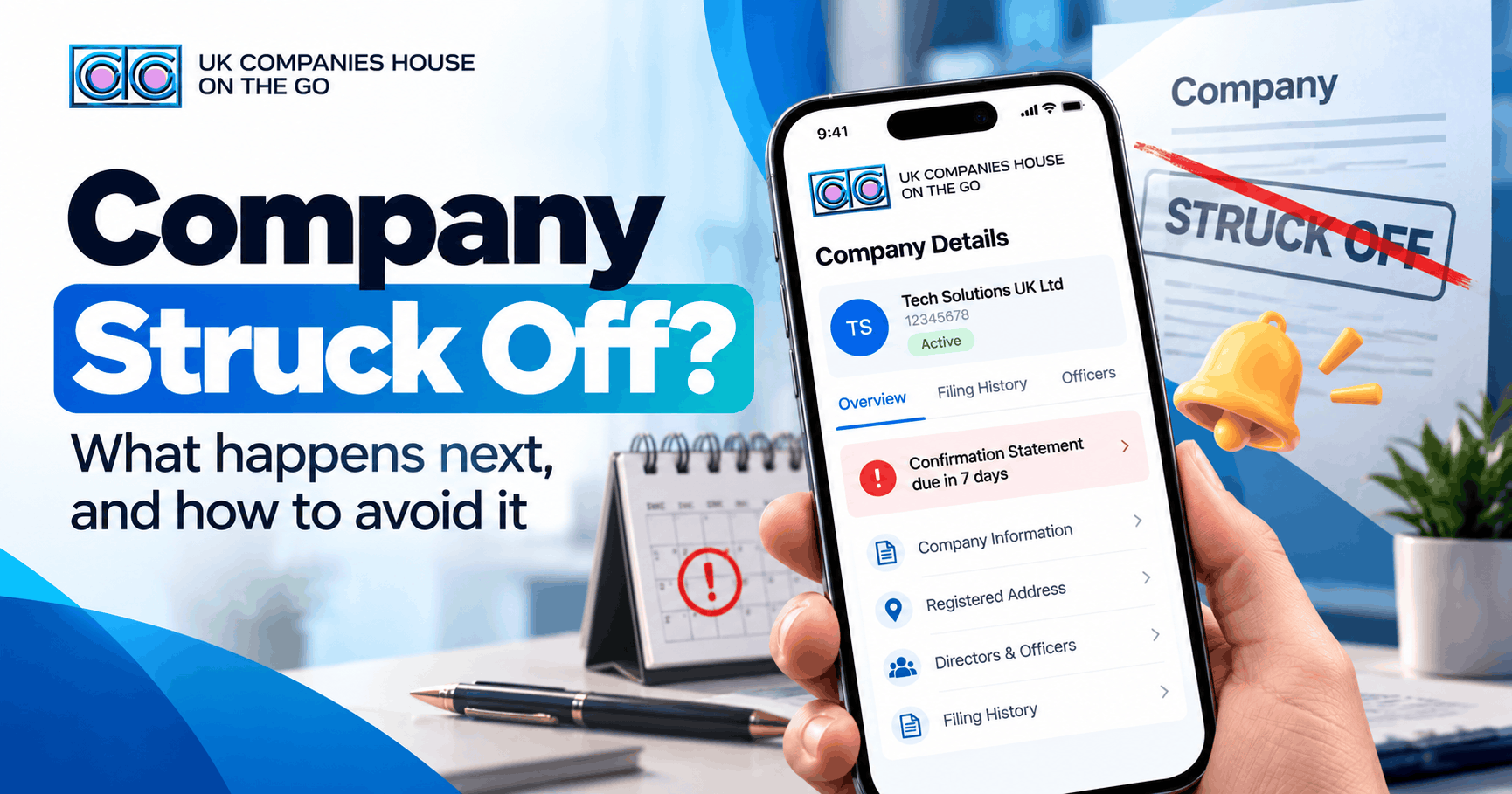
Companies on the Go is a company information and tracking app. It does not file documents for you, but it helps you see what is coming. You can:
- Search UK registered companies
- View company details, officers and filing history
- Save companies as favourites and keep them in one list
- Track accounts and confirmation statement dates, with alerts as they approach
You can see how it works or download the app for Android and iOS. The free plan covers up to 10 companies.
Conclusion
Filing deadlines are simple on their own. The trouble comes from forgetting them. Know your dates, set reminders and check your record regularly. A little organisation now is far cheaper than a penalty later.
Frequently Asked Questions
When are accounts due for a new company?
First accounts are due 21 months after the date of incorporation.
How long do I have to file a confirmation statement?
You have 14 days after the end of your 12-month review period.
Is there a penalty for a late confirmation statement?
Late accounts carry an automatic penalty. A late confirmation statement can lead to prosecution and strike-off, so do not leave it.
What if I cannot meet a deadline?
You can apply for an extension only in limited circumstances, and you must apply before the deadline. Penalties can be appealed online.
How do I check my company’s deadlines?
Your company’s page on the Companies House register shows the due dates. An app such as Companies on the Go can also track them for you.